
An IPO Investor is any person or institution that buys shares during the initial sale. These investors pay money to the company before the shares are listed on the stock exchange. They hope to earn a profit in an IPO investment once the share price rises. The buying process differs from regular stock trading. The company completes the share allotment within seven days after the offer closes.
Different people and groups participate in the process when a company sells its shares to the public for the first time through an IPO investment. They are grouped in categories. This article explains them on-by-one.
Read: IPO Meaning
IPO Investment Categories
An IPO Investor Category is a specific group defined by the market regulator. The Securities and Exchange Board of India (SEBI) sets different rules for each group. These rules cover the minimum application size and the total number of shares reserved. They also define how the company will distribute shares if too many people apply.
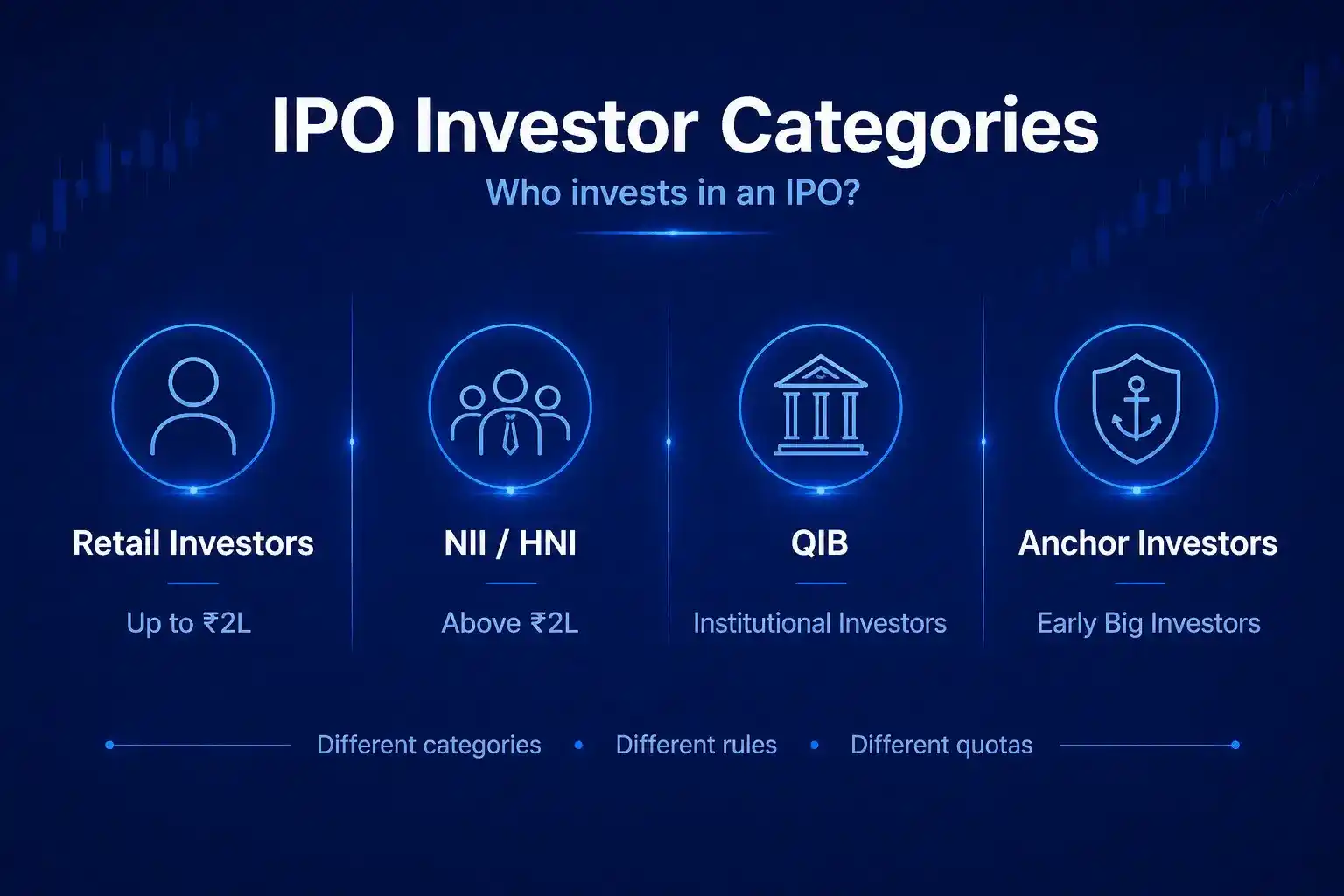
Retail Individual Investors (RII)
Retail Individual Investors are common people who invest small amounts. This category includes resident Indians and Non-Resident Indians. Hindu Undivided Families also apply under this tag.
The reservation depends on the profitability of the company. A profitable company must keep at least 35% of shares for RIIs. A firm with the QIB route retains only 10 per cent of the shares by the retail investors. The fixed-price issues set aside 50 percent on this category.
In case demand is low, all the applicants get all the number of shares. The company operates a lottery system in case there are many demands, and everyone gets to receive one or more lots.
Example: An IPO is over-subscribed twice. Each available lot is applied to by two people. One out of every two applicants is being selected by the lottery. Such an individual gets a single lot, contrary to the ten lots he or she had applied.
- Mainboard vs SME – Rules on SME IPO investment were revised by SEBI on 1 July 2025. During Mainboard IPO investment, you may apply for one lot, of a maximum value of 2 lakhs. RII is not a term in SME IPOs; instead, you must apply to two full lots, which usually are more than 2 lakh rupees.
- Other features – Retail investors may submit a bid at the cut-off price, that is, they have to accept the final price that the company decides. They will be able to withdraw their application during the time the IPO is open. These shares do not have a lock-in period, they can be sold on the first day of listing.
Learn about the complete process of IPO Application.
Non Institutional Investors (NII)
NIIs are buyers who bid for more than Rs 2 Lakhs. High-net-worth individuals, companies, trusts, and societies belong to this category. It now has two sub‑groups:
The NII category will be receiving 15 percent of the total shares. A third of this portion of 15 per cent. is allocated to Small NIIs, and two-thirds is allotted to Large NIIs.
- Mainboard vs SME – In Mainboard IPO investment, NIIs start bidding above Rs 2 Lakhs. In SME IPOs, NIIs must bid for at least 3 lots. The Small NII limit for SMEs stops at Rs 10 Lakhs. Large NIIs in SMEs bid for values above Rs 10 Lakhs.
- Other features – NIIs cannot bid at the Cut-off price. You must mention a specific price. You cannot withdraw your bid once you submit it. You can only increase your bid price. There is no lock-in period for NII shares.
The process uses a lottery if the IPO is popular. Each selected investor gets the minimum NII lot size. Any extra shares are given based on proportion.
Example: If the sNII part is full two times, a lottery happens. Only half of the applicants get the minimum NII application value.
Qualified Institutional Buyer (QIB)
QIBs are financial experts who manage other people’s money. Mutual funds and commercial banks are the best examples. Foreign Portfolio Investors also belong to this group. These entities must register with SEBI to participate.
Profitable companies have 50% of QIB in IPOs. Companies without a profit track record give 75% to them.
QIBs usually bid on the last day of the IPO. They cannot withdraw their application. There is no lock-in period for regular QIBs. They can sell shares immediately after listing.
Anchor Investors
Anchor investors are a special type of QIB in IPOs. They buy shares one day before the IPO opens for everyone else. They provide confidence to other investors. Their participation shows that big players trust the company.
The company can give up to 60% of the portion of QIB in IPOs to anchors. The minimum investment for Mainboard IPOs is Rs 10 Crore. For SME IPO investment, the minimum is Rs 2 Crore.
Anchors cannot withdraw their bids. They must pay the full amount at the time of application. They have a mandatory lock-in period. They can sell 50% of their shares after 30 days. They can sell the remaining 50% only after 90 days.
Eligible Employees and Eligible Shareholders
Eligible Employees – The company reserves some shares for its own staff. This includes full-time employees and directors. Employees of the parent company or subsidiaries can also apply. The reservation cannot exceed 5% of the total post-issue capital. The company shares all details in the prospectus.
Employees often get a discount on the share price. This discount stays within 10% of the price for others. The maximum investment limit is generally Rs 5 Lakhs. You get the discount only on the first Rs 2 Lakhs. There is no lock-in period for employee shares.
Eligible Shareholders – This category is for people who own shares of the parent company. You must hold those shares on a specific date mentioned by the company. The company decides the quota size for its shareholders. You can find this in the Red Herring Prospectus.
Shareholders can apply in both the retail and shareholder categories. This increases your chances of getting shares. You might also get a special discount. Mainboard IPOs allow the cut-off price option for bids below Rs 2 Lakhs. There is no lock-in period for these shares.
The Difference between Different IPO Investor Categories in India
Check out the summary of IPO Investment categories below:
| Feature | Retail (RII) | NII / HNI | QIB | Anchor Investors |
|---|---|---|---|---|
| Investment Limit | Up to Rs 2 Lakhs | Above Rs 2 Lakhs | No upper limit | Min Rs 10 Crore |
| Quota (Profit Route) | At least 35% | At least 15% | Up to 50% | Up to 60% of QIB |
| Lock-in Period | None | None | None | 30 to 90 Days |
| Withdraw Bid | Yes | No | No | No |
| Cut-off Price | Yes (Mainboard) | No | No | Not Applicable |
















No comments yet. Be the first to share your thoughts!