
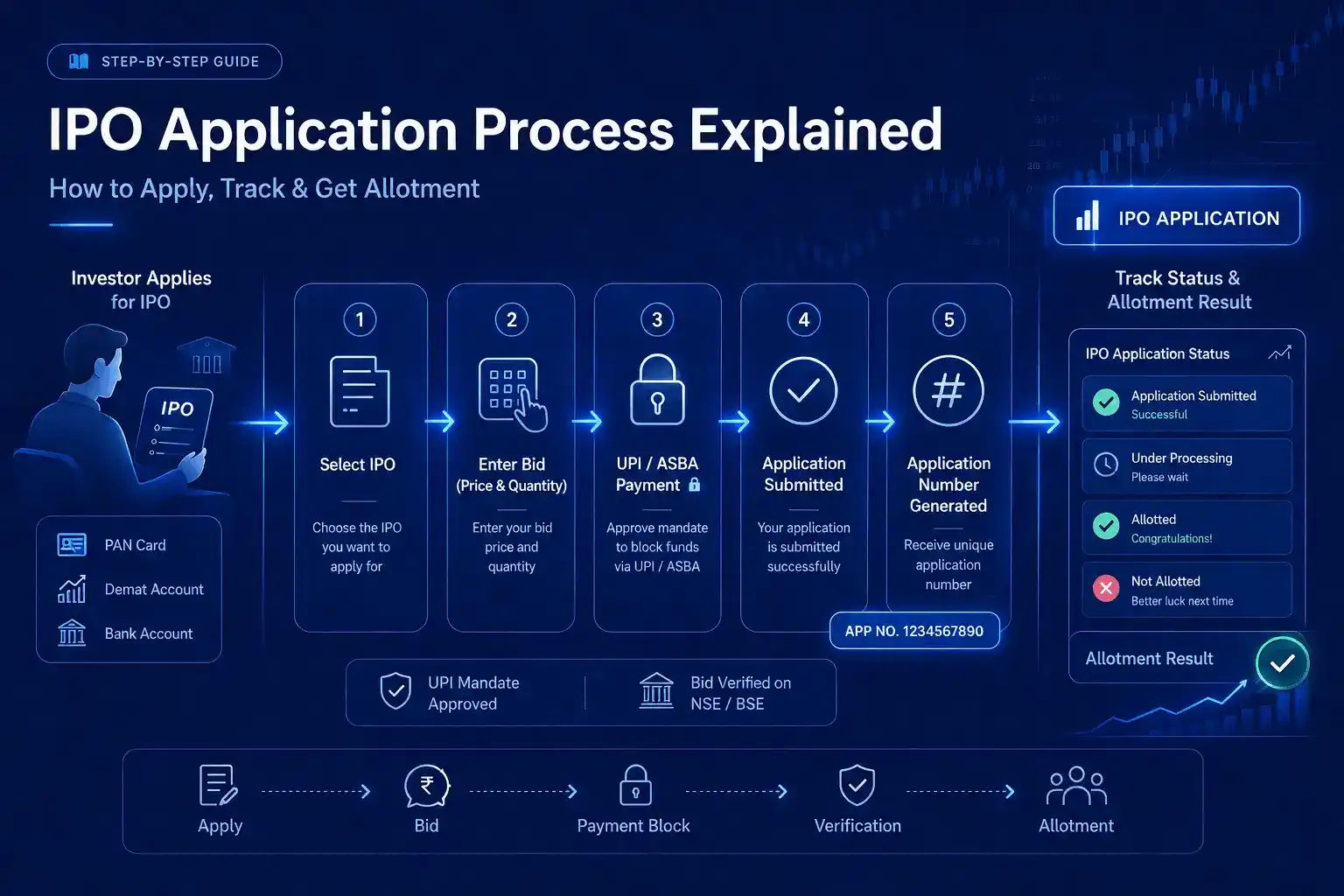
IPO Application

IPO Application

An IPO application is a formal request for shares. It acts as your entry into the stock market world. Each application gets a unique IPO application number that serves as a reference for your transaction and helps you track your bidding status. The system generates this number once the broker submits your bid to the exchange. Online applications get this number between IPO timing of 10 AM and 5 PM.

IPO Application Meaning

IPO Application: It is used to bid for shares of a company that is listing on the stock market for the first time (IPO). You must submit your bid when the issue stays open. You cannot apply after the subscription period closes. People also call this the IPO bidding process.

The IPO application form, a formal request, has this number printed on it already, and it is called the application number. You need this number to check your allotment later.

Read: What is IPO?

Rules and Validity

The stock market has strict rules for IPO applications. You must follow them to avoid rejection.

  • PAN Rule: You can submit only one application per PAN card. The system rejects multiple applications under the same PAN.
  • Bank Account: You must pay from your own bank account. The name on the bank account must match the applicant’s name.
  • Payment Block: The application becomes valid only after the bank blocks the funds. This IPO process is called a lien.
  • UPI Limit: Only retail investors can use the UPI facility.
  • ASBA Usage: All types of investors can use the ASBA facility.
  • Demat Accounts: You cannot apply from two different Demat accounts under one name.
  • Joint Accounts: You can use a joint bank account if you are the first holder.
  • Third-Party Apps: You can apply through Google Pay or PhonePe via UPI.
  • Duplicate Bids: The exchange does not allow duplicate applications.

Investor Categories

You must choose a category when you apply. Each category has a different quota of shares.

Investor CategoryMainboard LimitSME IPO Limit
Retail Individual (RII)Up to ₹2 Lakhs2 Lots
Small NII (sNII)₹2 Lakhs to ₹10 Lakhs3 Lots up to ₹10 Lakhs
Big NII (bNII)Above ₹10 LakhsAbove ₹10 Lakhs
QIBNo specific limitNo specific limit
EmployeeAs per RHPAs per RHP
ShareholderAs per RHPAs per RHP

The rules forbid bidding in multiple categories like RII and NII together. Your application will face rejection if you mix these.

IPO Bidding Options (Multiple Bids)

You can bid in more than one category only if special categories exist. These include the Employee or Shareholder categories. An investor can apply as an RII and also as a Shareholder. This does not count as a duplicate bid.

Mainboard IPOs allow retail investors to bid at the “Cut-off Price”. This means you accept the final price decided by the company. SME IPOs do not allow the cut-off price option. You must enter a specific price for SME bids.

IPO Application Process and Forms

You can apply for an IPO through two main methods.

Online Application

Most investors prefer the online method. You can use your bank’s net banking or mobile apps. Stock brokers also provide online IPO platforms. You use UPI or ASBA for the payment.

  • Log in to your broker or bank portal.
  • Select the specific company name.
  • Fill in your bidding details.
  • Review all the information carefully.
  • Submit your form.
  • Complete the payment process through UPI or ASBA.

Offline Application

You can use a paper form for an offline application. You must submit this physical form to your broker. You can also visit a bank branch that accepts IPO forms. The IPO application form is a two-page document. The first page contains your details and bid amount. The second page contains the instructions. You can download BSE / NSE IPO form in PDF format from the respective websites. You can also get them on the IPO INDEX site.

Read Article: IPO Process

IPO Application Charges and Time

Investing in an IPO is usually free for the investor. Banks and brokers do not charge you for the application. They earn a commission from the company instead. However, you pay a brokerage fee when you sell those shares. Some brokers, like Zerodha, offer free delivery trading. In that case, the entire IPO process stays free.

An IPO apply time usually stays open for 3 to 10 days. The stock exchanges accept bids from 10 AM to 5 PM. You can submit online applications 24 hours a day during the period. The broker forwards these bids to the exchange at 10 AM the next day. The last day is very important. Most banks close the ASBA window between 2 PM and 4 PM. You should check the exact IPO cut off time with your bank.

Read: IPO Application Cancellation and Modification

What happens After IPO Application?

You can monitor your bid after submission. The broker app usually shows the status in the IPO section. Common status messages include:

  • Application under process.
  • Application executed.
  • UPI Mandate pending.
  • Bid submitted.

Verify Status on NSE or BSE

You can verify your bid directly on the exchange websites. This ensures your broker actually submitted the bid.

  • NSE Website: The NSE provides a verification tool. You must register once with your PAN details. You can see your bid details for six days after the IPO closes.
  • BSE Website: Visit the BSE IPO application check link. You need to enter the issue name and your application number. You can also use your PAN number for this search. The website shows the status after you pass the CAPTCHA test.


Frequently Asked Questions

What is an IPO application?

An IPO application is a formal request from an investor to purchase shares of a company before it goes public.  This application is submitted through your bank or broker to participate in the public offering.

What is the full form of IPO?

Initial public offering

Where can I check my IPO application status?

You can check your allotment status on the IPO registrar’s website, such as Link Intime or KFintech. Alternatively, log in to your stockbroker’s app or visit the NSE and BSE websites using your PAN.

Can I apply for IPO online?

Yes, most investors apply online using the UPI method through their trading apps or net banking. This is a fast and paperless IPO process that blocks the bid amount in your bank account directly.

How to apply for IPO offline?

To apply offline, you must visit a designated bank branch or your broker’s office to submit a physical ASBA form. You need to provide your Demat details, PAN, and bid information on the printed application.

How to apply for IPO step by step?

Steps to apply for an IPO –

  • Log in to your broker’s app 
  • Select the active IPO from the list. 
  • Enter your bid price and quantity, then provide your UPI ID to receive a mandate request. 
  • Approve the mandate on your banking app; the application is complete.

Where to get IPO application form?

You can download the NSE / BSE IPO form from the official websites of the Bombay Stock Exchange (BSE) or National Stock Exchange (NSE). Many banks also provide these blank application forms in their net banking portals under the ASBA section. Visit IPO INDEXIPO forms page to download.

Where to get IPO application number?

The application number is generated instantly once you submit your bid on the broker’s platform or bank portal. You will also receive this number via an SMS and email confirmation from the exchange.

Can I apply IPO without Demat account?

No, you cannot apply for an IPO without a valid Demat account. The shares you win in the allotment process must be stored in digital form in your Demat account you sell them.

What is the last date to apply for IPO?

The last date is the final day of the public bidding window (the third or fifth day of the issue). You must complete your application and approve the payment mandate with the official IPO timing before the closing time, usually 5:00 PM.

How to fill IPO application form?

  • Fill in your name, PAN number, and DP ID accurately in the designated columns. 
  • Select the number of lots you want to buy 
  • Mention the bid price or tick the cut-off price box.
  • Submit

Can retail investors apply for an SME IPO?

Yes, retail investors can apply for SME IPOs, but the minimum investment amount is usually between ₹1 lakh and ₹1.5 lakh. Whereas with mainboard IPOs, you must buy shares in large fixed lots rather than small quantities.

Can I apply IPO with different bank account?

Yes, you can use any bank account that supports UPI or ASBA, but the bank account must belong to the primary applicant. The PAN card on the bank account must match the PAN card on the Demat account.

Can I apply IPO after-market hours?

You can place an “After Market Order” (AMO) for an IPO through your broker at any time. However, the broker will only send your bid to the exchange when the market opens the next morning.

Can I apply IPO with different Demat account?

  • You can use different Demat accounts to apply for different IPOs
  • You cannot submit multiple applications for the same IPO using one PAN. In other words, if you use different Demat accounts with the same PAN, it will lead to rejection.

Can I apply IPO through credit card?

No, you cannot use a credit card to apply for an IPO in India. The payment must be made through a bank account via UPI or ASBA to ensure the funds are actually available and blocked.

Can I apply for an IPO on Saturday?

No, the IPO bidding window is only open on bank working days from Monday to Friday. You cannot submit or process bids on Saturdays, Sundays, or public holidays; outside IPO apply time.

What is IPO application number?

The IPO application number is a unique digit code assigned to your specific bid. It is used to track your status on the registrar’s website and to identify your transaction in the exchange records.

What is bid 1 bid 2 bid 3 in IPO application?

These options allow you to specify three different price points at which you are willing to buy the shares. Most retail investors ignore this and simply choose the “cut-off” price to increase their chances of allotment.

What is beneficiary account number in IPO application?

The beneficiary account number is your 8-digit or 16-digit Demat account ID, where the shares will be credited. You must enter this correctly to ensure the shares reach your account after the allotment.

What is the IPO cut off time in the application?

The IPO cut-off time is the final deadline on the last day of the IPO when the stock exchange stops accepting applications. For the exchange, this is usually 5:00 PM on the closing day. However, banks and brokers often close their UPI/ASBA payment windows earlier, typically between 2:00 PM and 4:00 PM. You must complete your application and approve the payment mandate before your bank’s specific IPO cut off time.

What is cut off in IPO application?

Selecting the “cut-off” price means you agree to buy the shares at whatever final price the company decides. This is the best strategy for retail investors to ensure their application is not rejected due to a low bid price.

What is DP name in IPO application?

The DP name refers to the name of your stockbroker or the institution where you hold your Demat account, such as Zerodha, Angel One, or ICICI Securities. It identifies the Depository Participant responsible for your shares.

Can I apply for an SME IPO in the HNI (NII) category?

Yes, if your total application value is more than ₹2 lakhs, you will automatically fall under the NII category. This allows you to bid for larger amounts, though the allotment rules for HNIs are different from retail.

Can NRIs apply for an SME IPO?

Yes, NRIs can apply for SME IPOs using their NRO or NRE bank accounts. They must ensure their Demat account is updated with the correct NRI status and linked to a valid PIS (Portfolio Investment Scheme) account if required.

Sanjay Bambhaniya
Bansi Shah
Writer
Bansi is your guide to IPOs and the Indian stock market. As a professional in investments, she simplifies and writes knowledge base and news articles to help all investors better understand complex financial topics.
Discussion & Feedback
0 Comments

No comments yet. Be the first to share your thoughts!