
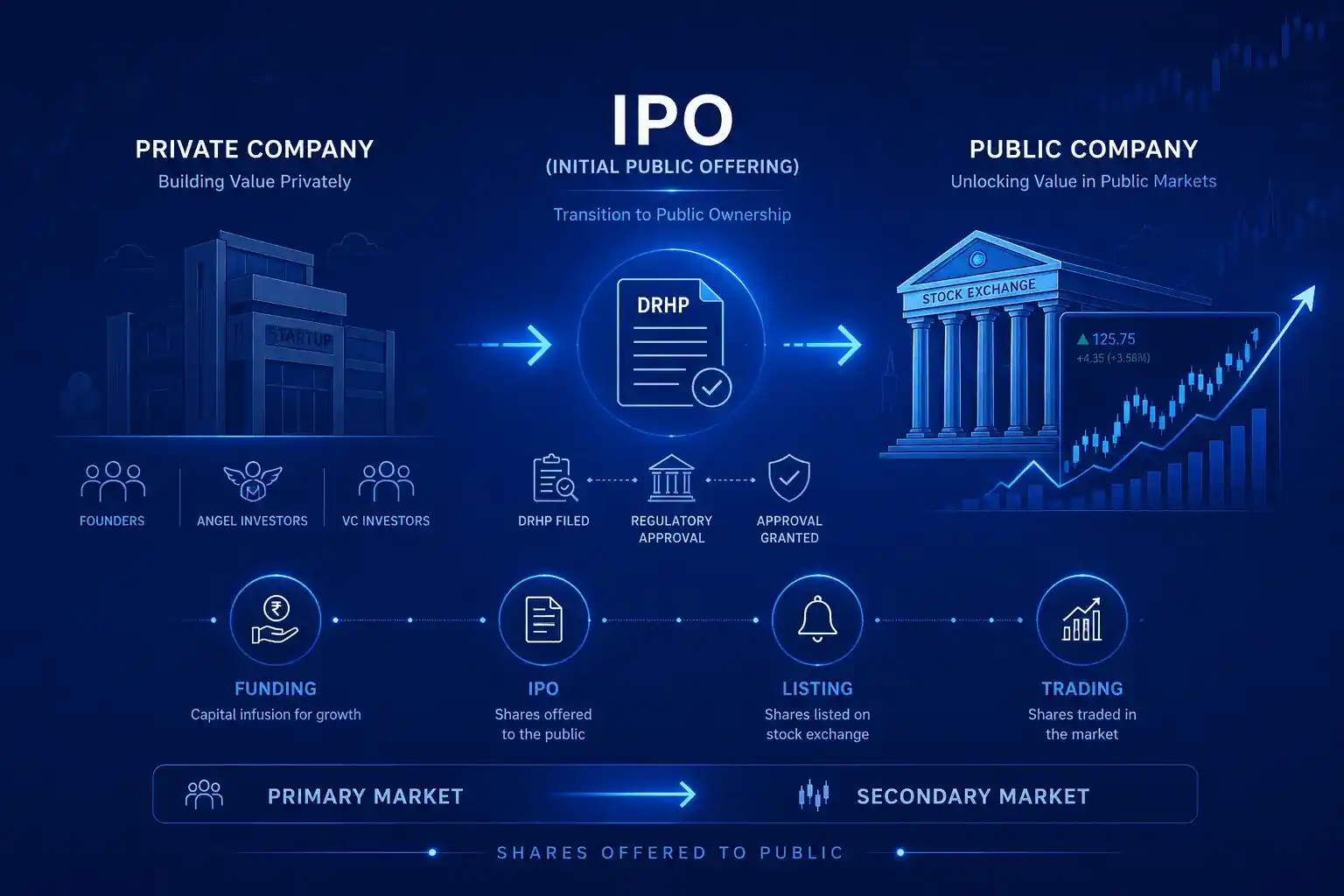
IPO fullform is Initial Public Offering. This process happens in the primary market. The primary market is the place where new securities are born. Investors buy shares directly from the company here. Once the IPO process ends, the shares move to the secondary market for regular trading.
IPO Meaning: It is the process where a private company sells its shares to the general public for the first time. The company moves from being private to being a publicly-traded entity on the stock exchanges.
1. Why Does a Company Issue IPO Shares?
To understand the IPO meaning further, know the reasons for issuing IPOs. A company goes through many stages of funding before it reaches the IPO stage. It starts with self-funding or money from friends. Then it moves to Angel Investors and Venture Capitalists. Later it might take Private Equity or Bank Loans. Each stage has its own limits.
Companies choose to go public for several logical reasons. The most common reason is the need for a large amount of capital. A growing company needs funds to build new factories or expand into new cities. Sometimes the original owners want to sell their stake to make a profit. This is their reward for building the business from scratch. Another major reason is the repayment of existing loans. High debt can put a lot of pressure on a company. An IPO provides interest-free funds to clear these old debts.
Reasons to Issue IPO Shares
- Exhaustion of Other Sources: Angel investors and venture capitalists have a fixed capacity to provide money. A company eventually reaches a point where these sources are not enough. It then looks at the public as a massive pool of capital.
- Retaining Management Control: Private equity investors often demand a say in how the company runs. They might take away the control from the original founders. Selling shares to the public allows the founders to keep the management control in their hands.
- Avoiding Interest Burdens: Bank loans come with a heavy cost of interest. The company must pay back the principal and the interest regardless of its profit. IPO funds do not require any interest payments. This makes the company’s balance sheet look much healthier.
- The Exit Route: Early investors who took a risk during the initial years want a way out. An IPO allows them to sell their shares to the public and exit the company with a good return on their investment.
2. IPO Types: Mainboard IPO vs. SME IPO
IPO Meaning for the Mainboard and SME categories:
Mainline or Mainboard IPOs are from the big players in the industry. These companies have a long track record of profits. They must follow very strict SEBI guidelines. These shares are very easy to buy and sell because the trading volume is high.
SME IPO platform is for startups and smaller businesses. The entry barrier is lower for companies but higher for investors. An investor needs at least Rs 2 lakhs to apply for one lot. The merchant banker must ensure there is a buyer in the market for three years. This is called market making.
The table below clarifies the differences to give the respective IPO meaning.
| Features | Mainboard IPO | SME IPO |
|---|---|---|
| Company Size | Large and established companies | Small and Medium Enterprises |
| Paid-up Capital | Minimum Rs 10 crores post-issue | Maximum Rs 25 crores post-issue |
| Regulator | Vetted directly by SEBI | Vetted by the Stock Exchange |
| Application Size | Rs 10,000 to Rs 15,000 | Minimum Rs 2 lakhs |
| Reporting | Quarterly audited accounts | Half-yearly audited accounts |
| Underwriting | Not mandatory | Mandatory for the issue |
| Trading Platform | Regular NSE and BSE | BSE SME or NSE Emerge |
3. IPO Benefits and Disadvantages
Every IPO has two sides for the company and the investors. You should weigh these carefully to know the real IPO meaning.
Benefits to the Company
Disadvantages for the Company
Benefits to the Investors
Disadvantages for Investors
4. IPO Application Cancellation and Modification
Sometimes an investor changes their mind after applying for an IPO. The rules for cancellation depend on your category.
Rules for Different Categories
The Cancellation Process
If you used the ASBA (Net Banking) method, you must log in to your bank’s portal. You find the order book in the IPO section. You click on the withdraw button to cancel the bid.
For the UPI method, you go to your broker’s app. You select the active bid and click on delete. You must also remember to reject the mandate in your UPI app.
Conclusion
Timings and Refunds – The exchange window stays open from 10 AM to 5 PM. Most banks stop taking requests by 2 PM or 3 PM on the final day. Brokers like Zerodha have specific windows for cancellation. There are no charges for cancelling an IPO application. The bank usually unblocks your funds within 24 hours of a successful cancellation.
This article explains the IPO meaning and concepts from various angles. You can now go on to reading the IPO process and other articles to get a comprehensive grasp of IPOs.

















No comments yet. Be the first to share your thoughts!