
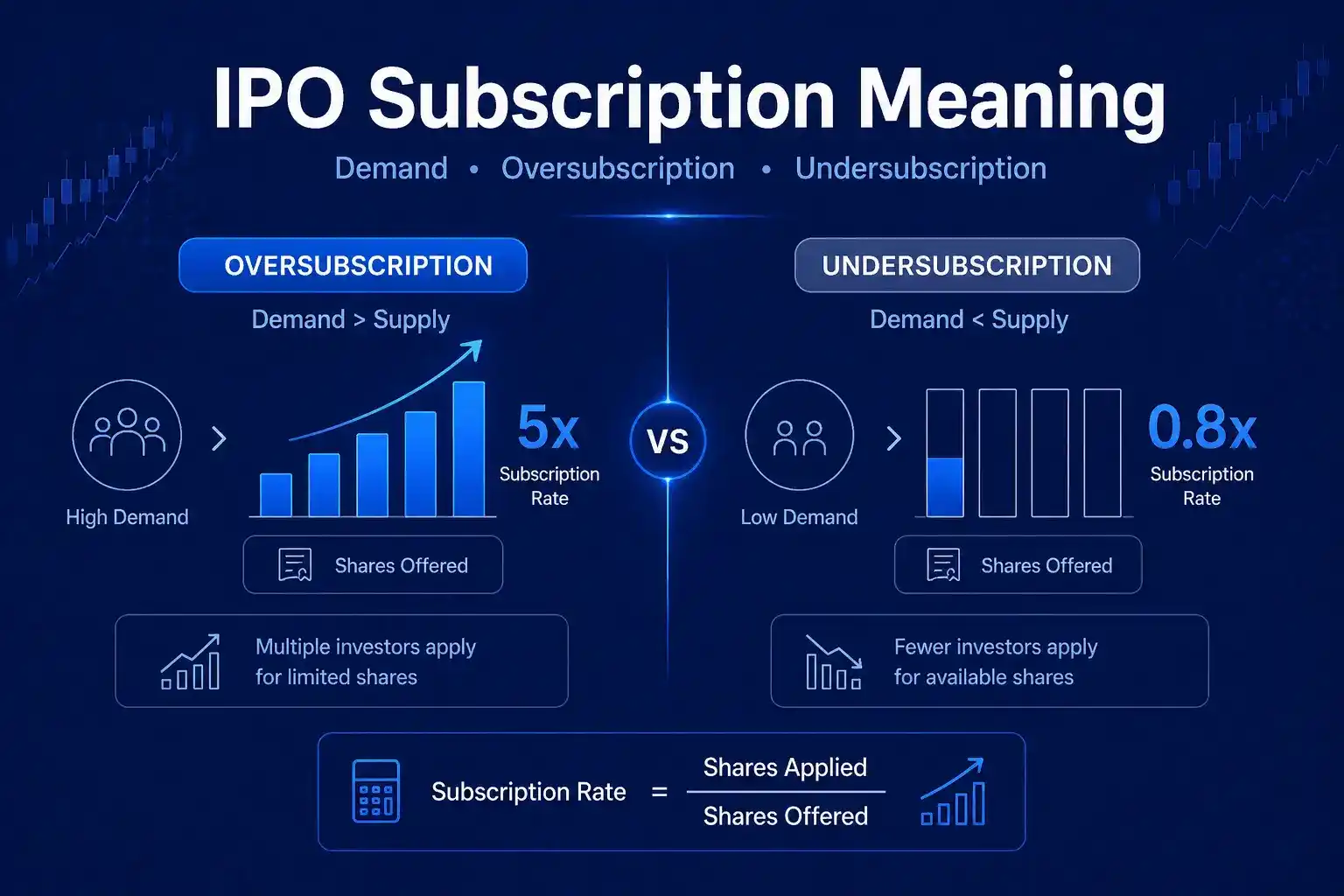
IPO subscription is a very simple concept for every stock market investor. It shows the total demand for the shares of a company. A company brings an IPO to raise money from the public. The IPO subscription data tells us how many people want to buy those shares. This data shows the total number of applications and shares requested by investors. You can see IPO subscription status live during the bidding period. It is available on the websites of BSE and NSE.
IPO Subscription Types, Process, Charges, Time, and Calculator
There are two main types of IPO subscription.
The first one is Oversubscription. This happens when the demand is higher than the supply. Suppose a company offers 10 lakh shares to the public. Investors apply for 50 lakh shares in total. We say the IPO is oversubscribed 5 times. This is a very good sign for the company and the investors. It often leads to a higher listing price on the stock exchange.
The second type is Undersubscription. This happens when the demand is lower than the supply. Suppose a company offers 10 lakh shares. Investors only apply for 8 lakh shares. This means the demand is low. In India, an IPO must get at least 90% subscription to be successful. If it fails to get this minimum demand, the company must return the money to the investors.
The IPO Subscription Process
The process of IPO subscription involves several steps. You start by placing a bid through your bank or stock broker.
- You submit your online application through platforms like Zerodha or ICICI Bank. Your broker or bank sends this data to the stock exchange. The stock exchange collects all bids from different brokers.
- The exchange shows the live demand on its website between 10 AM and 5 PM.
- The exchange sends the final data to the Registrar (RTA) after the closing date. The Registrar checks the applications and decides the allotment of shares.
- The Registrar instructs the banks to unblock the money if you do not get shares. You receive the shares in your demat account one day before the listing date.
IPO Bidding Options
When you apply for an IPO, you have to make certain choices. You must decide the number of shares and the price.
IPO Subscription Charges and Timing
Investors do not have to pay any fees for subscribing to an IPO. The stock brokers and banks provide this service for free. They get a small commission from the company for processing your application. You only pay brokerage and taxes when you sell the shares in the secondary market.
The IPO window usually stays open for 3 to 10 business days. You can submit your bid online 24 hours a day during this period. However, the bank only uploads your bid to the exchange between 10 AM and 5 PM. Most brokers close the window around 2 PM or 3 PM on the last day. They need this extra time to process your request and send it to the exchange before the 5 PM deadline.
Investors can submit IPO bids anytime during the IPO period. Banks/brokers upload bids to the exchange between 10 AM and 5 PM on the IPO close date only after the UPI mandate is approved.
IPO Subscription Calculator
The calculation of the subscription rate is very easy. You take the total number of shares bid for by investors. You divide this by the total number of shares offered by the company.
Subscription Rate = Total Shares Bid}/{Total Shares Offered}
For example, if the bid is for 4,38,36,954 shares and the offer is for 1,88,30,372 shares, the rate is 2.33x. Most investors check these numbers directly on financial websites like IPO INDEX.
Investor Categories
The stock market has different buckets for different types of investors. The company reserves a specific percentage of shares for each group. You can check the IPO subscription status NSE/BSE data for below categories.
IPO Subscription Relation with Listing Price and GMP
The IPO subscription status live is a powerful tool for predicting the future price of the stock. A high subscription number shows strong interest from the public.
Relation with Listing Price – A heavily oversubscribed IPO usually lists at a higher price than the offer price. The high demand continues even after the shares list on the exchange. This creates “listing gains” for the lucky investors who got the allotment. However, the market sentiment also plays a big role. A bad market can pull down the price even for a good IPO.
Relation with Grey Market Premium (GMP) – The Grey Market is an unofficial market where people trade IPO shares before listing. The GMP is the extra amount people are willing to pay over the issue price.
Conclusion: How Subscription Data Helps You
IPO subscription status NSE / BSE data helps you build a smart strategy. You can see which category has less competition. For example, if the retail category is full but the shareholder category is empty, you might get a better chance there. It also tells you about the risk. Low subscription shows that big investors do not trust the company. This helps you avoid bad investments and protect your capital. IPO INDEX provides Live IPO Subscription Status.















No comments yet. Be the first to share your thoughts!