
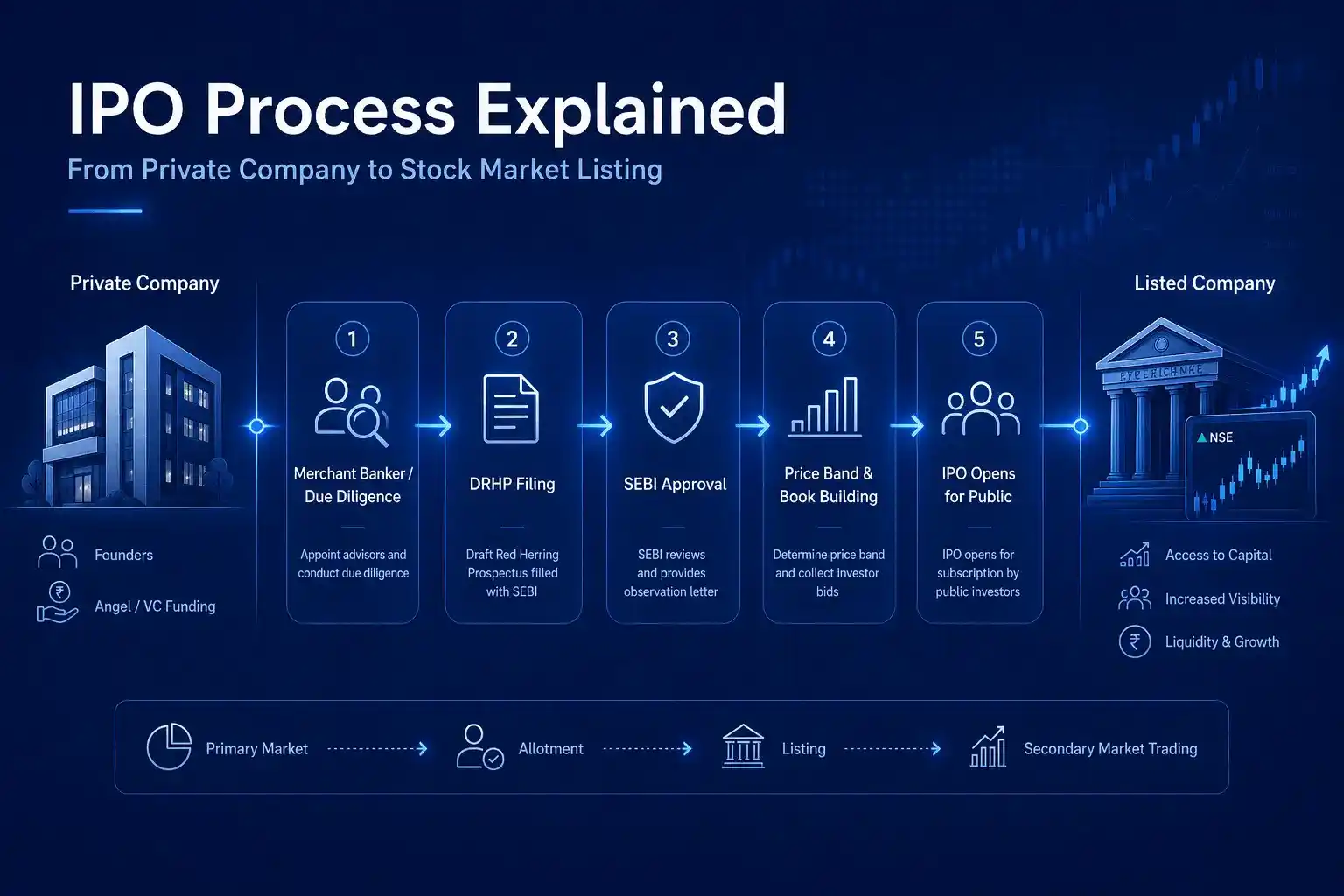
Many companies want to grow their business fast. They need a lot of money for this growth. They invite the general public to invest in their company. This first invitation is the Initial Public Offering or IPO. SEBI is the main regulator of the Indian stock market and IPO rpocess. It makes rules to protect small investors. A busy IPO India market shows a strong economy.
The IPO process starts when a company decides to go public. It ends when the shares start trading on the stock exchange. The entire journey involves many legal steps. Every company must follow these rules strictly.
Full Step-by-Step IPO Process
This IPO process ensures that only valid companies enter the market. It gives a fair chance to every investor to own a piece of a growing business. The total time for an IPO process varies. A Mainboard IPO process usually takes 6 to 12 months. An SME IPO process is faster and finishes in 3 to 4 months.
Read on the 12-step IPO process below.
1. Appointment of a Merchant Banker
The company first hires a Merchant Banker in their IPO process. People also call them Lead Managers. These experts manage the entire IPO journey. They handle the legal work from start to finish. The Lead Manager checks all company records. This check is called due diligence. They help the company prepare the main document for the IPO. This document is the DRHP.
*DRHP full form – Draft Red Herring Prospectus.
A Merchant Banker must have a registration with SEBI. They provide financial advice to the firm. They also help in finding the right price for the shares. Big companies often hire more than one Lead Manager for their IPO process. Most large banks in India have a merchant banking license.
2. Getting Approval from SEBI
The company submits the DRHP to SEBI. SEBI officers look at every detail in the document. This review process takes two to four months. SEBI checks if the company is telling the truth to investors. They may ask the company to change some information. The company can only move forward after SEBI gives the green signal.
There is a small difference for smaller companies. SME IPOs do not go to SEBI for approval. The stock exchange itself reviews and approves SME IPO documents. This makes the process faster for small businesses.
3. Application to Stock Exchanges
The Merchant Banker sends the IPO application to the stock exchanges. These are usually the NSE and BSE. The exchange verifies the identity of the company. They check if the company meets the listing criteria. The exchange then gives an “in-principle” approval. This means the company is fit to list its shares on their platform.
4. Deciding the Share Price
The company and the Lead Manager sit together to fix the price. They use two main methods for this IPO process task. The first one is the Fixed Price method. Here, the company tells the exact price before the IPO opens. Investors know exactly what they are paying per share.
The second method is the Book Building process. Most companies use this method today. The company gives a price range or a price band. For example, the band might be 100 to 105 Rupees. Investors can bid for shares within this range. The final price comes out only after the bidding ends. Retail investors and big institutions both participate in this bidding.
5. Filing the Red Herring Prospectus (RHP)
The company updates the DRHP with the latest financial numbers. This updated version is the Red Herring Prospectus. They file this document with the Registrar of Companies. The RHP contains the final dates of the IPO India process. It also mentions the price band for the shares. Investors read this document to understand the risks of the business. It is the most important book for any serious investor.
6. The IPO Roadshow
The company needs to tell people about its IPO. The Merchant Banker and ad agencies start a marketing campaign. This phase is the IPO Roadshow. The company owners travel to different cities. They meet big investors and fund managers. They also talk to journalists and market analysts. The goal is to create a positive buzz in the market. Good marketing helps the IPO get more subscriptions.
7. Opening for Anchor Investors
Some big institutional investors get an early chance. These are Anchor Investors. They must apply for at least 10 Crore Rupees. The company gives them shares one day before the public IPO opens. This shows that big players trust the company. It gives confidence to small retail investors.
8. The Public Issue Opens
The IPO finally opens for the general public. It usually stays open for three to ten days. Investors use their bank accounts or brokers to apply. They submit their bids through the UPI or ASBA process. Every investor gets a unique application number. The money stays blocked in the bank account. It does not leave the account until the company allots the shares. Submitting a bid does not mean you will get shares for sure.
9. Allotment of Shares
This is an important step in the IPO process. The bidding closes and the data goes to the IPO Registrar. The Registrar is an independent body. They check all applications for mistakes. They verify the PAN card and demat account details. They reject applications if the name on the bank account is different.
If too many people apply, the Registrar holds a lottery. This is the basis of allotment. Lucky winners get the shares in their demat account. The bank then deducts the money from their account.
People who do not get shares usually see the money unblocked in their bank account within 1 to 2 days after the allotment process is completed.
10. Announcement of Listing Date
The company sends all final papers to the stock exchange. They get a credit confirmation from the depository. This confirms that shares are now in the accounts of investors. The stock exchange then releases a public circular. This circular tells everyone the final listing date. It also mentions the trading symbol and the final price.
11. The Listing Day
The shares finally start trading on the stock exchange. This happens in two parts on the first day.
- The Pre-Open Session:
This session starts at 9:00 AM and ends at 9:45 AM. It helps find the true opening price. Investors can place or cancel orders during this time. The system matches these orders to fix the start price.
- Normal Trading:
Regular trading begins at 10:00 AM. Now, any person can buy or sell these shares. The price moves up or down based on market demand.
12. Post-Listing Formalities
The IPO process work does not end with the listing. The company must submit many reports to the exchange. They share their annual reports and audit details. They must tell the exchange about all board meetings. These rules ensure that the company remains transparent with its new shareholders.
Mainboard IPO vs. SME IPO Process
The IPO process has some key differences based on the size of the company.
| Features | Mainboard IPO | SME IPO |
|---|---|---|
| Review Authority | SEBI reviews the documents. | The Stock Exchange reviews them. |
| Market Maker | No market maker is needed. | A market maker is mandatory. |
| Reporting | They report results every quarter. | They report results every six months. |
| Platform | Main NSE or BSE boards. | NSE Emerge or BSE SME boards. |
Read more about IPO Meaning and Types in this article.
Conclusion
An Initial Public Offering (IPO) is a major event where a private company first sells its shares to the public. This detailed process is in control of SEBI (India’s market regulator) and is important for keeping the stock market clear and fair for investors. Each part or intermediary, such as the company wanting money and the investor looking for chances to grow, must understand this process. The IPO is the basic system that makes stock market investing in India work.
















No comments yet. Be the first to share your thoughts!