
IPO Subscription

IPO Subscription

IPO subscription is a very simple concept for every stock market investor. It shows the total demand for the shares of a company. A company brings an IPO to raise money from the public. The IPO subscription data tells us how many people want to buy those shares. This data shows the total number of applications and shares requested by investors. You can see IPO subscription status live during the bidding period. It is available on the websites of BSE and NSE.

IPO Subscription Types, Process, Charges, Time, and Calculator

There are two main types of IPO subscription.

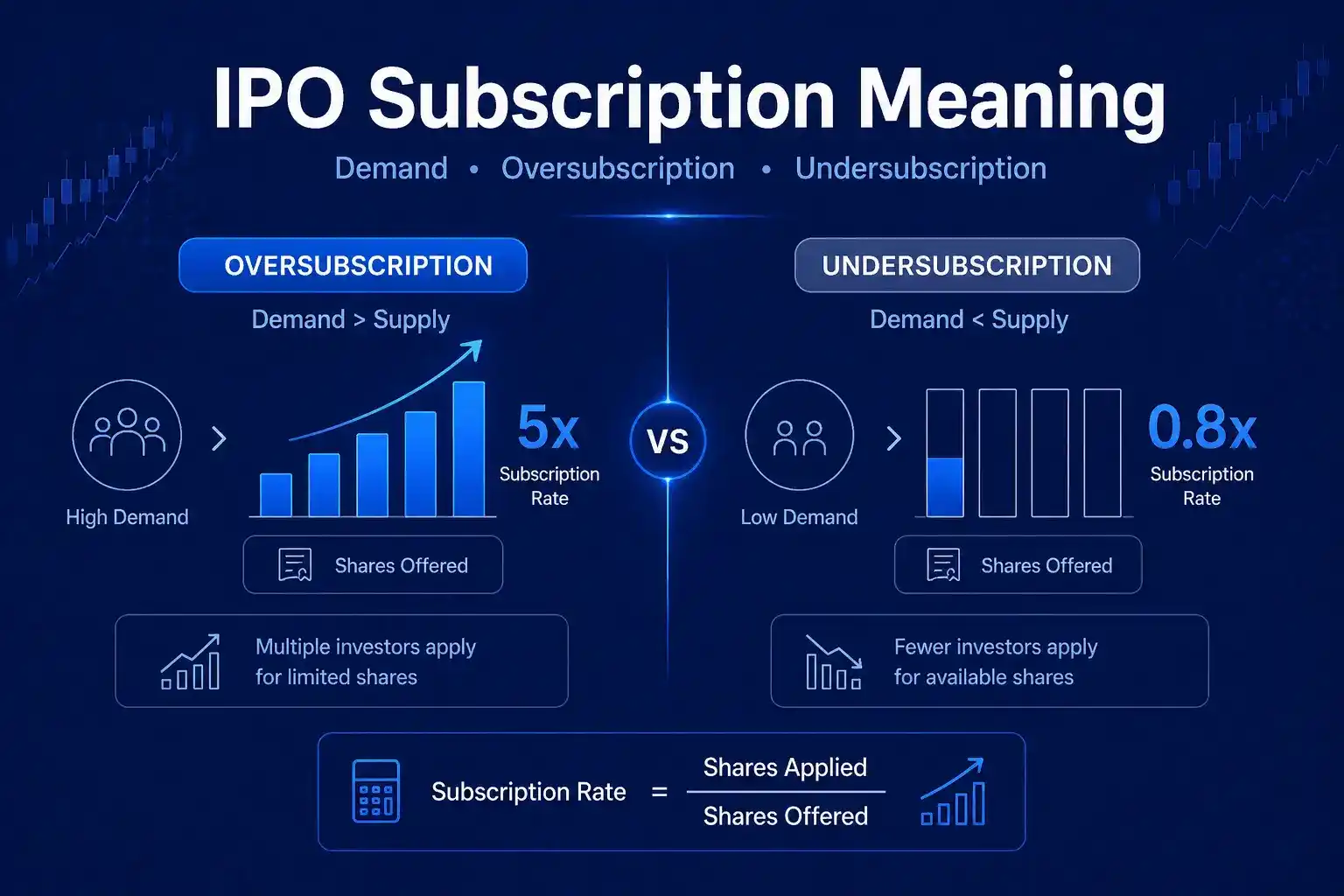
The first one is Oversubscription. This happens when the demand is higher than the supply. Suppose a company offers 10 lakh shares to the public. Investors apply for 50 lakh shares in total. We say the IPO is oversubscribed 5 times. This is a very good sign for the company and the investors. It often leads to a higher listing price on the stock exchange.

The second type is Undersubscription. This happens when the demand is lower than the supply. Suppose a company offers 10 lakh shares. Investors only apply for 8 lakh shares. This means the demand is low. In India, an IPO must get at least 90% subscription to be successful. If it fails to get this minimum demand, the company must return the money to the investors.

The IPO Subscription Process

The process of IPO subscription involves several steps. You start by placing a bid through your bank or stock broker.

  • You submit your online application through platforms like Zerodha or ICICI Bank. Your broker or bank sends this data to the stock exchange. The stock exchange collects all bids from different brokers.
  • The exchange shows the live demand on its website between 10 AM and 5 PM.
  • The exchange sends the final data to the Registrar (RTA) after the closing date. The Registrar checks the applications and decides the allotment of shares.
  • The Registrar instructs the banks to unblock the money if you do not get shares. You receive the shares in your demat account one day before the listing date.

IPO Bidding Options

When you apply for an IPO, you have to make certain choices. You must decide the number of shares and the price.

  • Lot Size: You cannot buy a single share in an IPO. You must apply for a minimum group of shares called a lot.
  • Price Band: The company gives a range like Rs 100 to Rs 105. You can bid at any price within this range.
  • Cut-off Price: This is the most popular option for retail investors. You select this to tell the exchange that you are willing to pay the final price decided by the company. This increases your chances of getting the allotment.
  • UPI Mandate: Most retail investors use the UPI method. You submit your ID and then approve the payment request on your mobile app. The bank blocks the money in your account. The money only leaves your account if you get the shares. You can also opt for an ASBA IPO from net banking.

IPO Subscription Charges and Timing

Investors do not have to pay any fees for subscribing to an IPO. The stock brokers and banks provide this service for free. They get a small commission from the company for processing your application. You only pay brokerage and taxes when you sell the shares in the secondary market.

The IPO window usually stays open for 3 to 10 business days. You can submit your bid online 24 hours a day during this period. However, the bank only uploads your bid to the exchange between 10 AM and 5 PM. Most brokers close the window around 2 PM or 3 PM on the last day. They need this extra time to process your request and send it to the exchange before the 5 PM deadline.

Investors can submit IPO bids anytime during the IPO period. Banks/brokers upload bids to the exchange between 10 AM and 5 PM on the IPO close date only after the UPI mandate is approved.

IPO Subscription Calculator

The calculation of the subscription rate is very easy. You take the total number of shares bid for by investors. You divide this by the total number of shares offered by the company.

Subscription Rate = Total Shares Bid}/{Total Shares Offered}

For example, if the bid is for 4,38,36,954 shares and the offer is for 1,88,30,372 shares, the rate is 2.33x. Most investors check these numbers directly on financial websites like IPO INDEX.

Investor Categories

The stock market has different buckets for different types of investors. The company reserves a specific percentage of shares for each group. You can check the IPO subscription status NSE/BSE data for below categories.

  • Retail Individual Investors (RII): This category is for small investors. You belong here if your total investment is less than Rs 2 lakhs. Companies usually reserve 35% of the issue for this group.
  • Non-Institutional Investors (NII): This group includes wealthy individuals and companies. They invest more than Rs 2 lakhs. NIIs are further divided into two parts. Small NIIs bid between Rs 2 lakhs and Rs 10 lakhs. Big NIIs bid more than Rs 10 lakhs.
  • Qualified Institutional Buyers (QIB): This group includes banks, mutual funds, and insurance companies. They are professional investors with big capital.
  • Anchor Investors: These are big QIBs who invest more than Rs 10 crores. They buy shares before the IPO opens for the general public.
  • Employee and Shareholder: Some companies reserve a small portion for their own employees or existing shareholders of the parent company.

IPO Subscription Relation with Listing Price and GMP

The IPO subscription status live is a powerful tool for predicting the future price of the stock. A high subscription number shows strong interest from the public.

Relation with Listing Price – A heavily oversubscribed IPO usually lists at a higher price than the offer price. The high demand continues even after the shares list on the exchange. This creates “listing gains” for the lucky investors who got the allotment. However, the market sentiment also plays a big role. A bad market can pull down the price even for a good IPO.

Relation with Grey Market Premium (GMP) – The Grey Market is an unofficial market where people trade IPO shares before listing. The GMP is the extra amount people are willing to pay over the issue price.

  • A high GMP usually leads to a high subscription rate.
  • Investors see the high GMP and feel confident about the profit.
  • If the subscription stays low despite a high GMP, it might be a warning sign.
  • Both factors together help you decide if you should borrow money to invest in the IPO.

Conclusion: How Subscription Data Helps You

IPO subscription status NSE / BSE data helps you build a smart strategy. You can see which category has less competition. For example, if the retail category is full but the shareholder category is empty, you might get a better chance there. It also tells you about the risk. Low subscription shows that big investors do not trust the company. This helps you avoid bad investments and protect your capital. IPO INDEX provides Live IPO Subscription Status.


Frequently Asked Questions

What does IPO subscription mean?

When a company offers its shares to the public for the first time, people apply to buy them. This process of people showing interest and applying for those shares is called IPO subscription.

How does an IPO subscription work?

Investors apply for shares through their bank (ASBA) or broker apps like Zerodha or Groww during the 3-day window. The amount is blocked in your bank account until the shares are given to you or the money is released.

What does oversubscribed IPO mean?

This happens when more people want to buy the shares than the company is offering. For example, if a company offers 100 shares but people apply for 500 shares, it is called an oversubscription.

What happens when IPO is oversubscribed?

The company cannot give shares to everyone when demand is too high. They use a lucky draw (lottery system) to decide who gets the shares, and many people might not get any shares at all.

How to know if IPO is oversubscribed?

Check the BSE/NSE IPO subscription status or financial news portals like IPO INDEX. If the number under the “Total” column is more than 1x, it means the IPO is oversubscribed.

Is oversubscribed IPO good?

Yes, as it shows that investors are very confident about the company. A highly oversubscribed IPO usually indicates a better chance of the share price opening at a profit (listing gains).

How can you get an oversubscribed IPO?

Shares depend purely on luck through a lottery system in a high-demand IPO. You can apply using different PAN cards of your family members for better chances instead of putting all the money in one account.

Can I get multiple lots in an oversubscribed IPO?

No, in the Retail category of an oversubscribed IPO, SEBI rules state that you can get a maximum of only one lot. Even if you apply for 10 lots, you will still only get one lot if you win the lottery.

What does undersubscription mean?

Undersubscription happens when the company offers more shares than the number of people applying for them. It means the public demand for that company’s shares is very low.

What happens if the IPO is not fully subscribed?

If the total number of applications falls short of the shares offered, every correctly applied applicant will receive their share. However, if the application total does not reach the 90% minimum threshold, the IPO could be cancelled.

What happens if IPO is underscribed?

The share price might fall on the listing day because there is not enough excitement in the market. Investors usually get the full number of lots they applied for.

What is under subscription of shares?

It is a situation where the number of shares applied for by the public is less than the number of shares the company wanted to sell. It shows a lack of investor interest.

What is under subscription and oversubscription of shares?

Under subscription means demand is less than supply (a bad sign as it shows low interest), while oversubscription means demand is higher than supply (a good sign as it shows high popularity).

What is 100x subscription in IPO?

This means the IPO has received 100 times more applications than the actual shares available. It is a sign of massive craze and usually leads to very high listing profits.

What does IPO 2x subscribed 2 times mean?

It means the company received double the applications for the shares it offered. For every 1 share available, there are 2 people competing to buy it.

What is 3x subscribed in IPO?

This indicates that the demand is three times the official offer size. It means the IPO is healthy and likely to have a good start on the stock exchange.

What is overall BSE / NSE subscription status in IPO?

This is the combined data showing how many times the IPO was filled by all categories, including Retail, HNI (High Networth), and QIB (Institutional) investors.

How much IPO subscribed?

To find this, you look at the total subscription figure. If it says 5.5x, it means people have applied for five and a half times more shares than what was offered.

What is the minimum subscription for IPO?

A company must get at least 90% of its shares subscribed to be successful. They have to return all the money to the investors in case of failure.

When can I get IPO live subscription data?

Live data is available during the 3 days when the IPO is open, usually from 10:00 AM to 5:00 PM. The numbers are updated every few minutes on the stock exchange websites.

How to check IPO subscription status live?

You can visit the “IPO” section on the official NSE or BSE websites. Many financial websites, like IPO INDEX also show live updates throughout the day.

How to check IPO subscription status NSE?

Go to the NSE India website, search for ‘Current IPOs,’ and click on the specific company name. It will show a table with live bidding details for each category.

Where to check IPO subscription status?

The most reliable places are the NSE and BSE websites and IPO INDEX. You can check your broker’s app or the website of the “Registrar” (like Link Intime or KFintech) for the final IPO allotment result.

What is the IPO subscription time?

An IPO stays open for 3 working days from 10:00 AM to 5:00 PM. You must submit your application and approve the UPI mandate within this time frame. Check IPO subscription status NSE / BSE data. Also, we provide the live status.

Can IPO be subscribed after market hours?

You can place an IPO order on your broker app anytime, but the broker will only send it to the exchange during market hours. UPI mandates must also be approved before the final deadline.

Can IPO subscription be cancelled?

Yes, you can cancel or delete your IPO application as long as the subscription window is still open. You cannot cancel it after that.

What happens after IPO subscription?

The company finishes the allotment process to decide who gets shares after the bidding period. After that, the money is refunded to those who did not get shares, and the company gets listed on the stock market.

What happens if IPO is fully subscribed?

100% (1x) subscribed means almost everyone who applied correctly will get the shares they asked for. The company successfully moves forward to list its shares on the exchange.

Sanjay Bambhaniya
Bansi Shah
Writer
Bansi is your guide to IPOs and the Indian stock market. As a professional in investments, she simplifies and writes knowledge base and news articles to help all investors better understand complex financial topics.
Discussion & Feedback
0 Comments

No comments yet. Be the first to share your thoughts!