
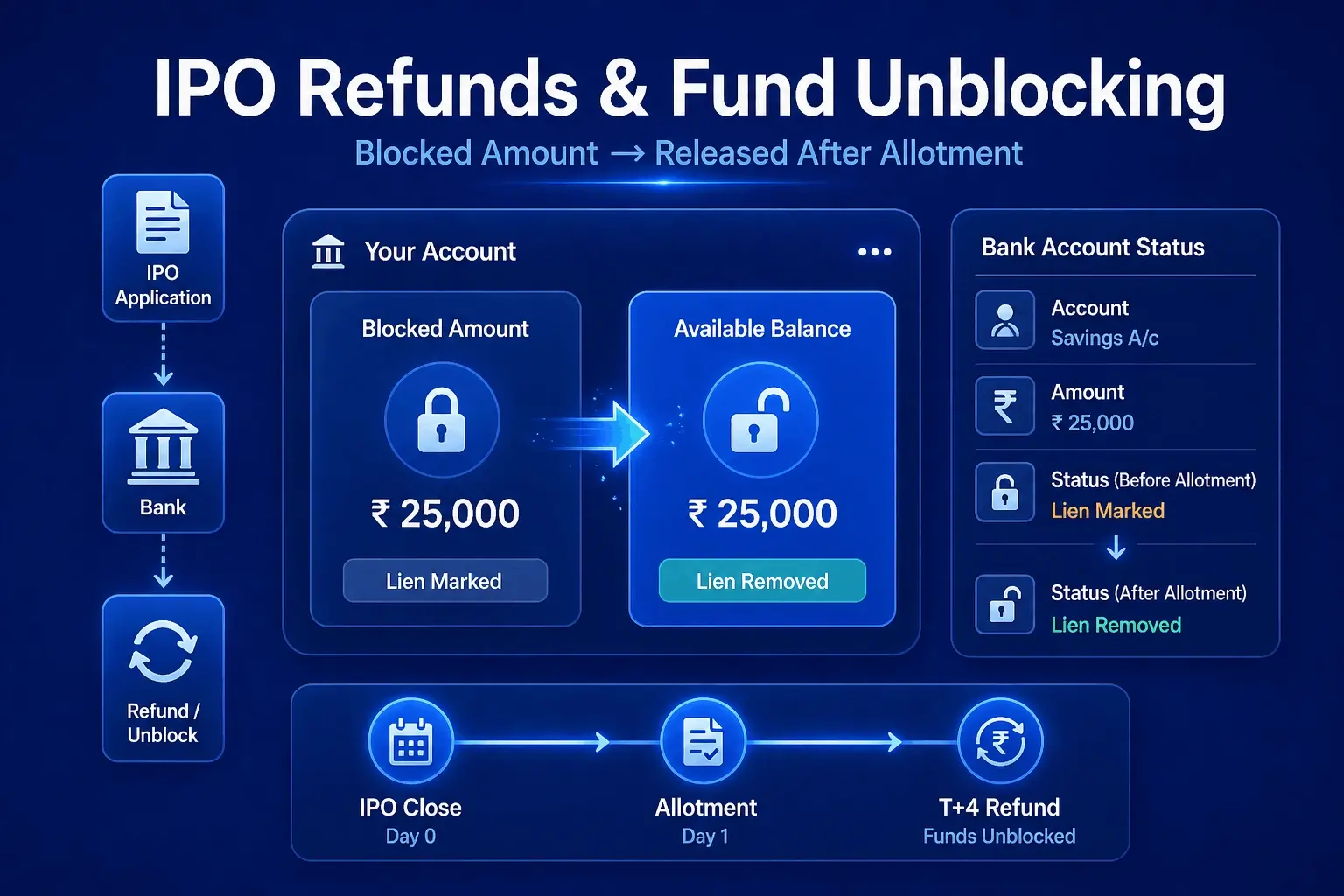
The bank freezes the required money in the application process of the Initial Public Offerings (IPOs). That is, the investor has the capital set aside to share allotment by marking a lien on the investors bank account. The bank only debits the amount of money that is needed to fund the allotted shares on the day of allotment and then releases the rest of the money.
IPO Refunds (Funds Unblocking) Meaning
The bank releases the amount in the IPO application as per the shares allocation status. The money becomes unlocked and the investor is free to use the money after unblocking.
Timeline on Refunds
The refunds of IPO should be done within four working days after the end of the public offer.
This particular date is different in each IPO and is outlined in the Red Herring Prospectus (RHP). The actual IPO funds unblocking dates must be verified by investors in the RHP or reputable financial websites.
The issuer is punished for not refunding or releasing the money within this period. The unsuccessful bidders are entitled to the subscription money back with interest charged by the issuing company.
The Refund Initiation Process
The IPO Registrar manages the refunding of IPO money. The Registrar is in charge of coordinating with the banks (Self-Certified Syndicate Banks (SCSBs)) to unlock the bank accounts and make the required refunds. The process is as follows:
The SCSB returns the IPO amount to the investors through different methods. The refund mode is based on the initial application mode and the type of investor.
| Mode of Refund | Instruction for Return of Funds | Investor Category |
|---|---|---|
| ASBA | Unblocking of the amount | Retail Individual Investor (RII), Non-Institutional Investor (NII), Qualified Institutional Buyer (QIB) |
| UPI | Revoke the mandate | Retail Individual Investor (RII) |
| Electronic mode (NACH, NEFT, RTGS, Direct Credit) | Dispatch of refund order to credit the Anchor Investor’s bank account | Anchor Investor |
Scenarios of IPO Refund (Unblocking of Funds)
The issuing company is legally required to issue the blocked funds in a number of situations:
- Non-Allotment or Partial Allotment – An investor might not be given any shares or may receive only a portion of the shares requested. In such cases, the registrar or the Self-Certified Syndicate Bank (SCSB) should unblock the whole amount or the part amount of the unallotted shares.
- Minimum Subscription not met – The offering should meet a minimum subscription (90% of the net offer size). In case of failure to meet this minimum threshold, the issuer must refund the subscription amount and release the money.
- Inability to Obtain Listing Approval – In some cases, the issuing firm does not receive permission to trade its securities in the given stock markets. In such instances, the issuer must repay the entire amount of IPO application money to the investors within four days after being notified of the rejection by the stock exchange(s).
- There is a lack of Allottees – The issue requires at least a minimum number of potential allottees to proceed. Mainboard IPOs must have at least 1,000 allottees and SME IPOs must have at least 200. The issuer should pay back the IPO subscription money when the number of successful bidders is less than these limits.
- Lack of Allotment to QIBs (Qualified Institutional Buyers) – The issues under the Qualified Institutional Buyer (QIB) route requires a minimum of 75 percent of the offer size to go to QIBs under the required book-building procedure. Failure by the issuing company to achieve this 75% allotment requirement would require the company to refund all the subscription money to all investors.
- Delayed or Unblocked Funds – Investors may have an amount that is not unblocked, or the refund credit is not delayed beyond the stipulated time. In such situations, investors have to undertake the following steps:
Investors can file an IPO refund complaint with SEBI via the SCORES website in case of no resolution from above seps. Alternatively, they can send a physical complaint request to SEBI. The investor may also call the Toll-free Helpline desk of SEBI at 1800 266 7575 or 1800 22 7575 to get guidance, status updates or queries. The Issuer might be required to incur interest at a rate of 15% per annum in the case of delay in the refund process or in case the remain unblocked beyond the stipulated time limits.
Conclusion
Remember, the money you block for an IPO is not immediately taken from your account; it is simply held via a lien. The unblocking is managed automatically by the IPO Registrar and your bank (SCSB). This process typically wraps up within four working days after the issue closes. The timeline and the steps in this blog ensure that, in case of delay, you can manage any issues.














No comments yet. Be the first to share your thoughts!